2026-08-20
Calibrating at half speed: the level tape
A reference tape entered the room: MRL Multifrequency Calibration Tape, catalog 243-101-450-110, serial 149 454 — 15 in/s, NAB equalization, 180 nWb/m reference fluxivity, all tones at 0 dB, five and a half minutes, quarter-inch, made July 2026 and wound tail out under an orange sticker that states its terms plainly: playback only, do not erase. One wrinkle worth recording before anything else: MRL's store sells this under the "Full Program" name, but the box and the enclosed graph both say Multifrequency Calibration Tape with a 243-series catalog number. Same substance either way — the contents match what was ordered.
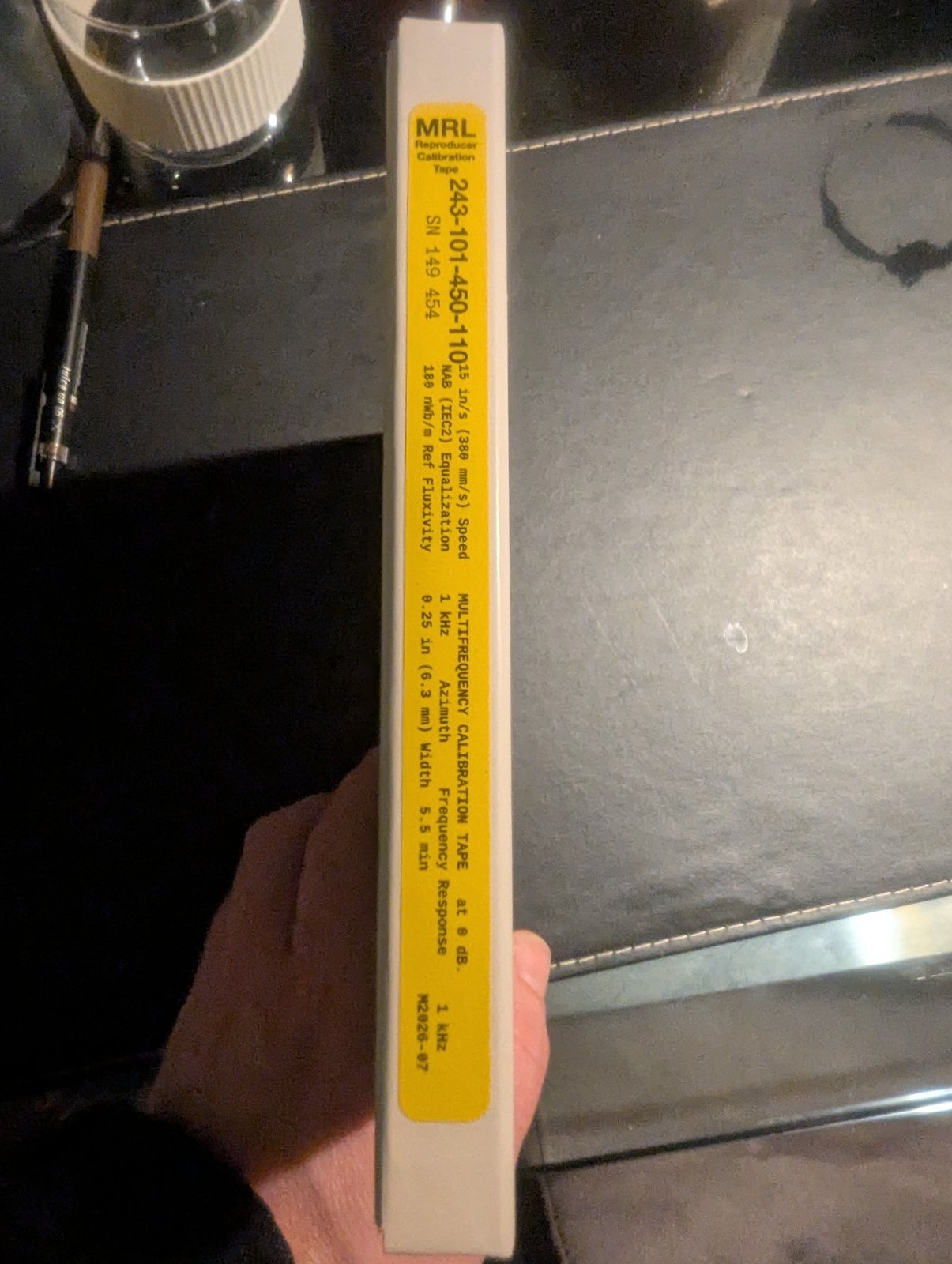 The MRL multifrequency calibration tape on its clear reel, sealed in its box, yellow catalog label across the hub and the orange playback-only sticker beside it
The graph reads first
Every MRL tape ships with a strip-chart of the actual reel, plotted during production — one millimetre per 0.2 dB, drawn with the ballistics of a standard VU meter (IEC 60268-17), which is exactly the instrument this tape is about to calibrate. This reel's graph (form G-1, production code M2026-07) is mirrored here as a PDF, and its trace hugs the omitted 0 dB centre line within about a millimetre end to end: the recorded levels are true to the label within roughly ±0.2 dB. The tone program, read off the graph's two staves in tape order:
| Section | Tones |
|---|---|
| Level set | 1000 Hz — the longest tone on the tape |
| Azimuth | 500 Hz, 8 kHz, 16 kHz |
| Frequency response | 32, 63, 125, 250, 500, 1k, 2k, 4k, 8k, 10k, 12.5k, 16k, 20k |
| Closing check | 1000 Hz again, brief |
The 1 kHz appears twice by design — set the level on the long opening tone, and confirm on the closing one that nothing drifted during the five-and-a-half-minute pass.
The speed problem, dissolved
The tape is cut at 15 in/s. The X-150D tops out at 7-1/2 — its specifications offer 15 in/s only with an optional capstan and pinch wheel this bench doesn't have. So the reel gets played at half speed, and the question is whether a 0 VU calibration taken that way can be trusted. It can, and the reasoning is worth writing down.
Halving the speed halves every tone's frequency — the opening 1 kHz arrives as 500 Hz — but the flux recorded on the tape doesn't change. The playback head's raw output drops 6 dB, because a head reads the rate of flux change. But NAB playback equalization rises exactly 6 dB per octave falling through its integration band, and the two effects cancel: for any tone whose halved frequency still lands between the NAB corners (3180 µs and 50 µs — 50 Hz to 3.18 kHz), the meter sees the recorded fluxivity, speed be damned. Conveniently, NAB uses the same two time constants at 15 and 7-1/2 in/s, so the EQUALIZER knob simply goes to 7-1/2 to match the playing speed.
The level lands true as well. MRL's own documentation identifies 180 nWb/m at 1 kHz as the old Ampex operating level — 185 nWb/m at 700 Hz under its modern name — which is precisely the "0 VU tape" a 1968 factory procedure meant. The residual difference, 20·log(180/185), is about a quarter of a decibel: inside the width of a VU needle.
Three boundaries on the method, so nobody trusts it further than it goes:
- Only the mid-band tones survive the speed change. The opening and closing 1 kHz (playing as 500 Hz) and the response tones from 125 Hz through 1 kHz (playing 62.5–500 Hz) all land inside the integration band. The 32 Hz tone arrives as 16 Hz, and everything from 2 kHz up crosses the 50 µs corner an octave displaced — at half speed those tones say nothing useful about this deck.
- The azimuth section is off the table too. Azimuth wants the short wavelengths; at half speed the 16 kHz tone plays as 8 kHz and the geometry argument no longer reads cleanly.
- A whisker of fringing. MRL cuts these tapes full-track; the X-150D's quarter-track head reads a little extra long-wavelength energy from the neighbouring tape area. At 500 Hz played speed the wavelength is short enough that the effect is a fraction of a decibel — negligible for a level set, but it's why the lowest response tones would read fat even at the right speed.
Where the pots are
The manual already says what to do with a 0 VU tone once one exists. Chapter VII of the service manual sets the playback gain first: play a 0 VU tape and adjust VR201, the 20KΩ (B) preset on the record/playback amplifier card, until the meter registers 0 VU — then sets the recording level against it via VR161, the 2KΩ (B) preset the same chapter names in running text. Both presets are seated with their values, part numbers, and sources in the component BOM. One preset per channel, and the tape is full-track, so both channels read the same reference on one pass.
The procedure, then: EQUALIZER to 7-1/2, tape mounted on the take-up side and rewound as the sticker instructs, long 1 kHz tone up, VR201 per channel until both meters sit on 0 VU, and the closing 1 kHz as the bracket check. The bench session that turns the pots gets its own entry — this one records why the numbers can be trusted before a single screwdriver comes out.